Wednesday, December 26, 2012

The Fiscal Cliff 101

This may not be a part of economic basics, but it is of extraordinary importance. If you have been living under a rock then you may not have heard of this possible calamity that may occur in less than a week. The Fiscal Cliff, if not stopped, will destroy our economy in an effort to lower our massive deficit. It is something that everyone must know about, and so that is why I am making a post about it.

In 2000, America had a large surplus where America was making much more money than it spent every year. President Bush wanted to use this surplus to implement more than one trillion dollars in tax cuts to the American people until December 31, 2010. By 2010, Obama was president, and he hated the Bush tax cut, but he did not want to increase taxes to the middle class, so he extended them, along with a few other programs, to the end of 2012. Meanwhile, a super committee was tasked with finding 1.2 trillion dollars in deficit reduction, and if they failed to do so, the 1.2 trillion dollars would automatically be cut from government spending starting on January 1st, 2013. As you can tell, they failed to do so. President Obama and John Boehner, Speaker of the House, have worked tirelessly in an effort to agree on a solution to prevent the cliff from hitting, but they cannot seem to agree. Obama wants to raise taxes for the top two percent of taxpayers and will allow some spending cuts, while Boehner wants to mainly cut wasteful government spending and try not to raise any taxes. Boehner, however, did say he would allow a tax increase to individuals making more than one million dollars, and this would almost cover half the needed deficit reduction.

The Fiscal Cliff will not be entirely bad; the massive spending cuts will drop the deficit by a significant amount, sending us closer to the surplus we miss. Unfortunately, however, these cuts will occur in every corner of government spending, and will cause large tax increases in every class, and programs like Medicare will have reduced funding. Unemployment will also increase sharply as a result of the cliff. Additionally, another recession will ravage the nation. I urge you all to research the Fiscal Cliff more, as it will be a very important event in the economic course of the country, and will effect every citizen.

Sources:
http://www.washingtonpost.com/blogs/wonkblog/wp/2012/12/17/the-fiscal-cliff-in-graphs-and-gifs/
http://en.wikipedia.org/wiki/United_States_fiscal_cliff#Effects_of_tax_increases
http://www.nytimes.com/2012/11/16/us/politics/the-fiscal-cliff-explained.html?pagewanted=all&_r=0

Tuesday, December 11, 2012

American Economic History

The United States is a country that has seen massive economic growth through its short life, rising from a small, struggling nation to an economic superpower. Coming out of the American Revolution, America had a terrible economy. The new nation was in massive debt and had no way of paying it off. After America gained independence, the government it set up was weak. The Articles of Confederation tied the states together as a union with very little central government to regulate the country's actions and economy. Most importantly, the government did not have the power to place taxes and tariffs on the citizens, and thus could not pay for war debts. The Constitution fixed this issue by giving the government more power so that it could allow the country to function.

It was like a whole new America. The country's productivity grew about 2% per year. The North manufactured ships while the South harvested crops on large plantations. Around 90% of Americans worked in the agricultural sector of the job market. Eli Whitney's invention of the cotton gin caused massive growth in the cotton industry in the South. The economy was also being improved by the invention of the steam engine, and its products like the steamboat and the train. This prosperity was short lived. The American Civil War had a devastating impact on all parts of the country, especially the economy. The American debt increased exponentially over the four year war. Most of the troubles were in the South while the North received increasing business. However, both sides experienced troubling inflation.

The Civil War had damaged the country gravely, but the ensuing decades showed extreme economic improvement. New inventions were improving manufacturing and commerce, which now dominated the economy. The business world was barely regulated by the government, which had its benefits and its drawbacks. On the positive side, large corporations flourished, and technology like steel and electricity spread quickly. The efficient production of these goods aided the economy greatly. However, the system has its flaws. For instance, the workers in a large corporation had bad living conditions and received little pay. Additionally, the system has its fair share of economic booms and recessions, which cause large amounts of unemployment. Some of these recessions were very serious. The Long Depression was a depression between 1873 and 1876 that brought unemployment to a staggering 14%. The Panic of 1893 caused so much damage to the economy that the president was forced to borrow tens of millions of dollars from tycoon J. P. Morgan. The recession was a large contributor to William McKinley's success in the 1896 presidential election. Prosperity continued into the 1900s with the invention of the affordable automobile, the assembly line, and the spreading of electricity. World War I brought increased taxes to Americans, and the end of the war saw a slight decrease from wartime taxes, but still higher taxes than there had been before the war. These taxes were lowered during the presidency of Warren G. Harding in the Booming '20s. The 1920s was a decade of prosperity in the United States. Much of this prosperity came from building construction and the automobile industry. The ever increasing popularity of the automobile created increasing prosperity in the oil and road-building industry.


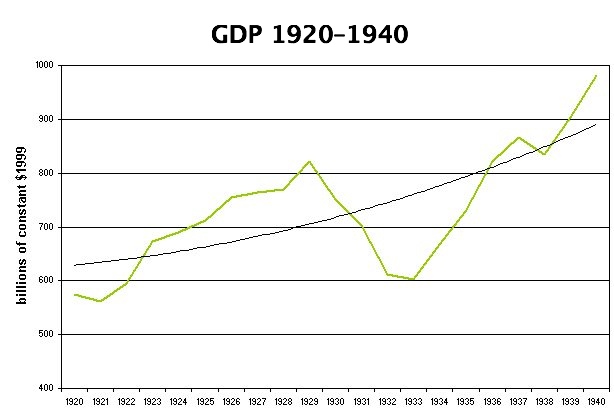
In late 1929, the stock market crashed, launching the world into the Great Depression. In three years, unemployment reached an astonishing 25% and about 40% of banks failed. President Franklin D. Roosevelt launched the New Deal in an effort to stimulate the economy. The New Deal was a series of government programs created to make employment increase and improve the economy. Some of the programs included Social Security, the Securities and Exchange Commission, and the Federal Deposit Insurance Corporation. The New Deal helped the economy vastly, but World War II helped an equal amount. In the early 1940s, many consumer product manufacturers were mobilized and were used to manufacture military equipment. As a result of the dramatically increased job opportunities, unemployment dropped to a record low.


World War II was followed by another time of economic prosperity in the United States. There was no class-favoritism with the improvement, each class experienced fairly equal economic growth. Soon after the war, America became the wealthiest country in the world, and had a steady footing as a superpower. The government improved labor rights and created programs like Medicare and Food Stamps to help the citizens. The prosperity, however, came to an end in the 1970s. Inflation and the increasing dependence on imported goods had a strong effect on the economy. Employment and productivity dropped. The national debt to other countries steadily increased through the 1980s. Throughout the 1990s, the debt increased 75%, the GDP grew 69%, and the stock market tripled. Finally, in 2008, the Great Recession started. The Great Recession will be covered in a later blog post about the current economic situation.

Sources:
http://eh.net/encyclopedia/article/baack.war.revolutionary.us
http://www.randomhistory.com/us-economy-history.html
http://www.economicshelp.org/blog/5002/economics/pros-and-cons-of-capitalism/
http://en.wikipedia.org/wiki/American_economic_history

Tuesday, December 4, 2012

Introduction to Economics

The economy is arguably the most pressing issues in the world of politics today. The world has been in a great recession for years now, and it has had a large impact on many countries from all over the globe. Because of this global economic crisis, the economy is a number one priority of leaders. In the recent presidential election, the economy played a huge role in the decisions of voters, as it should. I believe the economy should be the foremost factor in votes of any level, local or national. I am creating this blog as a public service to inform the public of the workings of the economy, and news relating to it. In this blog, I will explain how the economy has changed, what changes the economy, and the economic future, along with other subtopics of the economy. I believe any individual who wants to be involved with politics must know very much about this topic.

Economy is defined by the Oxford Advanced Learner's Dictionary as "the relationship between production, trade, and the supply of money in a particular country or region." Economy runs off of two rules that work with each other: the Law of Supply and the Law of Demand. Together, these laws show the relationship between the abundance of a good and its price. As a good becomes less abundant, the demand for that good rises, driving up the price. The system works backwards as well. When there is a surplus of a good, the demand is not as high, and the price is lowered. A very easy way to think of this is gasoline pricing. Gasoline was once a very abundant resource. Because of its high supply, the price of gasoline was fairly cheap. In recent years, oil has become increasingly difficult to obtain because of its limited supply. As a result, gasoline prices have increased rapidly over recent years. When gasoline was in high supply, the demand, along with the price, was low, but as gasoline becomes less abundant, it is in higher demand and the price grows.

Another very important term to know is recession. A recession is defined as "a significant decline in economic activity spread across the economy, lasting more than a few months, normally visible in real gross domestic product (GDP), real income, employment, industrial production and wholesale-retail sales" by the National Bureau of Economic Research. This definition could be rather long and difficult to follow for the uneducated, but it is fairly simple. A recession a rather short bout of economic inactivity, but even though it only lasts for a matter of months, it has a visible effect on many of the parts of the economy nationwide. This will be discussed in greater detail in later blog posts that will delve into the workings of the economy.

Sources:

http://oald8.oxfordlearnersdictionaries.com/dictionary/economy
http://www.sophia.org/economic-basics-supply-and-demand-tutorial
http://www.merriam-webster.com/dictionary/recession
http://www.investopedia.com/ask/answers/08/cause-of-recession.asp#axzz2E84uBqJI